$BALLing logN-RWA: A Household Stability Protocol
dany@logtrees.com · dtocil2@uis.edu
November 25, 2026 (draft)
Abstract. We propose an early productive UBI (PUBI) model combining ten years of verified achievement with new logN contributions. Earmarked $BALL identifies household participation. Recurring public support and optional employer or private bridges fund continuity, aiming to preserve household resources with less required work as AI changes the economy.
1. Introduction
A household's ten-year legacy anchors the proposed continuity layer during AI-driven job transitions. Each benefit period has committed funding; temporary inactivity does not erase continuity.
The proposed engine incentivizes supported non-zero-sum activities. logtrees records outcomes, logN estimates attributable net gains, and logN-RWA links participation to funded household rights [1]. Verified gains would guide further allocation of time and resources, aiming to expand productive capacity while households adapt.
2. Household record
The tether comprises a nontransferable household credential, an attributed $BALL balance in escrow, and a benefit schedule. Token transfers cannot transfer the household's identity or history. The schedule names the beneficiary, obligor, funding source, benefit, term, claim conditions and appeal process. Past income is evidence, not collateral or a claim on future labor.
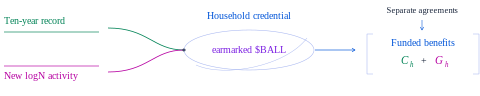
Members consent to submit records they lawfully control. Tax records are one source; nonfilers and caregivers need alternatives. Documents remain encrypted off-chain, with salted commitments and attestations published instead of identifying details. Proofs bind records to a root [4]; reviewers check authenticity and eligibility. Published rules cover unique enrollment, recovery and household changes.
3. Settlement
For household h in one period, support Rh consists of a funded continuity draw Ch and a variable award Gh for verified new contributions:
Rh = Ch + Gh;∑h (Ch + Gh) ≤ F
F is funding available for payment in the period, including authorized public payments and committed private bridges. Budget continuity and awards separately. Estimate gains conservatively against baselines, net of costs and uncertainty, without double counting. Estimates create no payment authority. The current $BALL token confers no artifact ownership or revenue claim [2]; household benefits require separate agreements. No federal guarantee is assumed.
4. Initial allocation
We propose earmarking 12,000,000 $BALL, the Game 5 Ball community token associated with Scottie Pippen [2]:
| Allocation | $BALL |
|---|---|
| Trump Account initiative | 2,000,000 |
| Illinois Accounts | 5,100,000 |
| Unallocated reserve | 4,900,000 |
Illinois Accounts is a proposed private program targeting one $BALL per household. A dated eligibility register fixes enrollment; if it exceeds the cap, use equal fractional grants. Undistributed tokens remain in reserve. The Trump Account earmark stays outside statutory accounts; any contributions require an authorized route and applicable limits [3].
5. Household example
The fictional Rivera household has a verified 2016-2025 record of employment, care, training and stewardship. AI reduces paid hours from 40 to 28 a week; proportional take-home earnings fall from $4,800 to $3,360. The $BALLing logN-RWA target is the same $4,800 monthly result with less required work time.
Assume an authorized public program, employers or private sponsors commit $17,280 for the pilot's first twelve-month funding period, covering $1,440 monthly. One earmarked $BALL identifies participation. This month's funded $240 logN award reduces the continuity draw to $1,200:
$3,360 + $1,200 + $240 = $4,800
Without a logN award, the public program or sponsor bridge supplies $1,440. Only verified gains available for payment reduce continuity funding. Assume two additional hours of AI-assisted logN activity weekly: 28 paid + 2 logN = 30 hours rather than 40, with other household duties unchanged.
Twelve months illustrates a pilot commitment, not the intended PUBI lifetime. Continuation requires authorized funding. Amounts are after assumed taxes and fees; no token sale or appreciation is assumed.
Recurring public payments could share support with employers and private sponsors [5]. Proposed monetary financing requires legal authority; states participate through budgets or transfers, and any Federal Reserve role follows its mandate [6]. Test anticipated productivity, tax receipts and public savings net of program costs before using them to justify renewal.
6. Conclusion
Test whether recurring PUBI preserves household resources, local spending and agency with less total work time. Measure net productive and fiscal gains, costs and price effects. With sustained funding, the program could carry households seamlessly through the transition to an economy upgraded by AI.
References
[1] logtrees. Elysium logtrees/logN Productive Settlement Overview. Informational companion.
[2] Game 5 Ball. Official project and token-rights disclosures.
[3] 26 U.S.C. 530A. Trump accounts.
[4] S. Nakamoto. Bitcoin: A Peer-to-Peer Electronic Cash System. 2008.
[5] Congressional Research Service. Resources for Grantseekers. Illinois. GATA State Grantee Portal New User Guide.
[6] Federal Reserve. Monetary and Fiscal Policy. GAO. Federal Payment Process. U.S. Constitution, Art. I, Sec. 10.